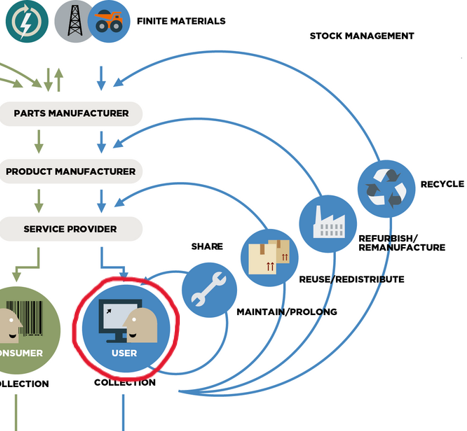
Customers (or users) are at the center of any company. This is even more the case in a circular economy. A product is preferably designed with the user in mind and the customer receives a product at the moment it is most valuable. The product is in the hands of the user when the lifetime can potentially be extended through maintenance and ultimately, a customer has a deciding vote on what will happen to a product after its first use.
Customer retention is a business’s ability to keep existing customers and continue to generate revenue from them.
Loyal customers can be of high importance to any company for many different reasons:
- Customer acquisition might be sexier than customer retention, but research shows it’s five to six times more expensive to find a new client than it is to reactivate an old client.
- Retained customers buy more often and spend more than newer customers. They've learned the value of a product or service and keep coming back, again and again.
- Satisfied, loyal customers are more likely to provide positive recommendations and refer their friends and family, bringing in new customers, free of charge.
Customer retention strategies can be applied throughout the customer or product life cycle.
Before a customer starts a relationship with a company, this company can already make sure that products are designed to last longer, can easily be maintained, are upgradeable and are easy to disassemble, allowing for countless opportunities to extend the relationship with the customer.
Also, the design of the transaction itself can influence customer retention. In a traditional seller/buyer construction the relationship can very well end after the transaction. When offering products through lease or pay-per-use type of constructions, additional customer touchpoints are automatically built-in. It is a well-known fact that stick-rates (customers that continue to use the products once the initial contract ends) in leasing are high, allowing for long, profitable relationships.
During the use of a product companies have a unique opportunity to strengthen the connection by providing superb customer service. This could be in the form of traditional maintenance of break/fix services but also upselling additional functionalities and extending the product lifecycle through upgrades can improve and lengthen the relationship.
Pitching upgrades or cross-selling to existing customers is a great way to generate more revenue for your business. It’s also easier than converting new customers because past buyers already know your product works and they have faith in your business 81 percent of customers report that they are more likely to shop with a business again after having a positive experience. If you’re able to retain customers, you’ll generate more revenue.
At the end of the first use period of a product an effective Trade-in program will lead to higher retention rates.
A trade-in program allows you to exchange your aged items for credit or discounts for the purchase of new ones. The value of the credit is typically determined by the condition and age of the item you’re trading in but also the product life cycle and market demand are important elements.
A trade-in program makes it more attractive to stay with a current brand as customer get a direct financial incentive to exchange their aged product for a newer product from the same brand.
At the same time, it makes customers aware of the value of their aged product. This is immediately taken into account when overthinking the purchase of a new product, increasing its perceived value.
Next to the financial value, trading-in, is also a good environmental practice. A manufacturer of a product will be more capable of retaining a product (at its highest value) than the user. By having a trade-in program companies show their social responsibility, increasing the brand reputation.
The trade-in process by itself is a nice opportunity for a company to get in contact with its customers and strengthen the relationship.
A good hassle-free trade-in process will improve the customer satisfaction and loyalty. These customers feel appreciated and are more likely to return and will tell their friends and relatives about the positive experience.
As with customer service, the execution of the trade-in program is essential. The entire process from start to finish will need to be at or above the customers’ expectations. This includes quoting, pricing, ordering, removal, transportation, payment and many other processes. A badly executing Trade-in process can encourage customers to start looking for better alternatives.
A trade-in Program, or and Trade-Up Program, allows customers to feel better about upgrading because they feel they are going to get some of their investment back. Channel partners benefit as they are able to offer a better solution to their clients while, at the same time, showing that they care about their client’s bottom line.
When creating circular solutions, we see great examples in product creation (create value with less impact) or the end-of-life management of product. Both of these are challenged by the traditional financial business cases. When we shift our focus from the products that we create to the customers that we serve, we see that circular solutions bring additional benefits that make many financial business case attractive.
Add comment
Comments